
How to Search Cases by Name
Begin with the free Indiana MyCase public search. Open the Name tab. Enter a last name or a business name, and leave the first and middle names blank if you like. A date of birth can narrow a party search, though it never appears as a public result field. Keep protected identifiers from a court file out of the query entirely.
One name may pull cases from across Indiana. Montgomery County has three active trial courts. Restrict the search to Montgomery Circuit, Montgomery Superior 1, or Montgomery Superior 2. Filing dates and case status trim the list further. The official MyCase search tips explain sound-alike matching and warn that results stop at 1,000.
- Open MyCase and select the Name tab.
- Enter the last or business name, then add first and middle names if known.
- Choose a Montgomery County court, case status, or filing-date range.
- Compare the caption, court, case type, and filing date before opening a result.
- Save the full case number for later Clerk questions.
| Field | Type | Required | Use |
|---|---|---|---|
| Last or business name | Text | Name mode | Primary party-name field |
| First and middle name | Text | No | Narrows common names |
| Date of birth | Date | No | Narrows a party query |
| Court | Dropdown | No | Select a Montgomery trial court |
| Status and file dates | Filters | No | Limits open, closed, and date results |
Montgomery MyCase Search Tabs
MyCase offers three modes: Case, Name, and Attorney. Case mode takes a case number, citation number, or cross-reference number. Name mode hunts for parties. Attorney mode works from a bar number or a lawyer's name. Pick the right tab, because the same text means something different in each mode.
The public MyCase interface template documents every one of these controls on its search screen. Montgomery County case searches begin in a state system. The Clerk keeps the official local file.
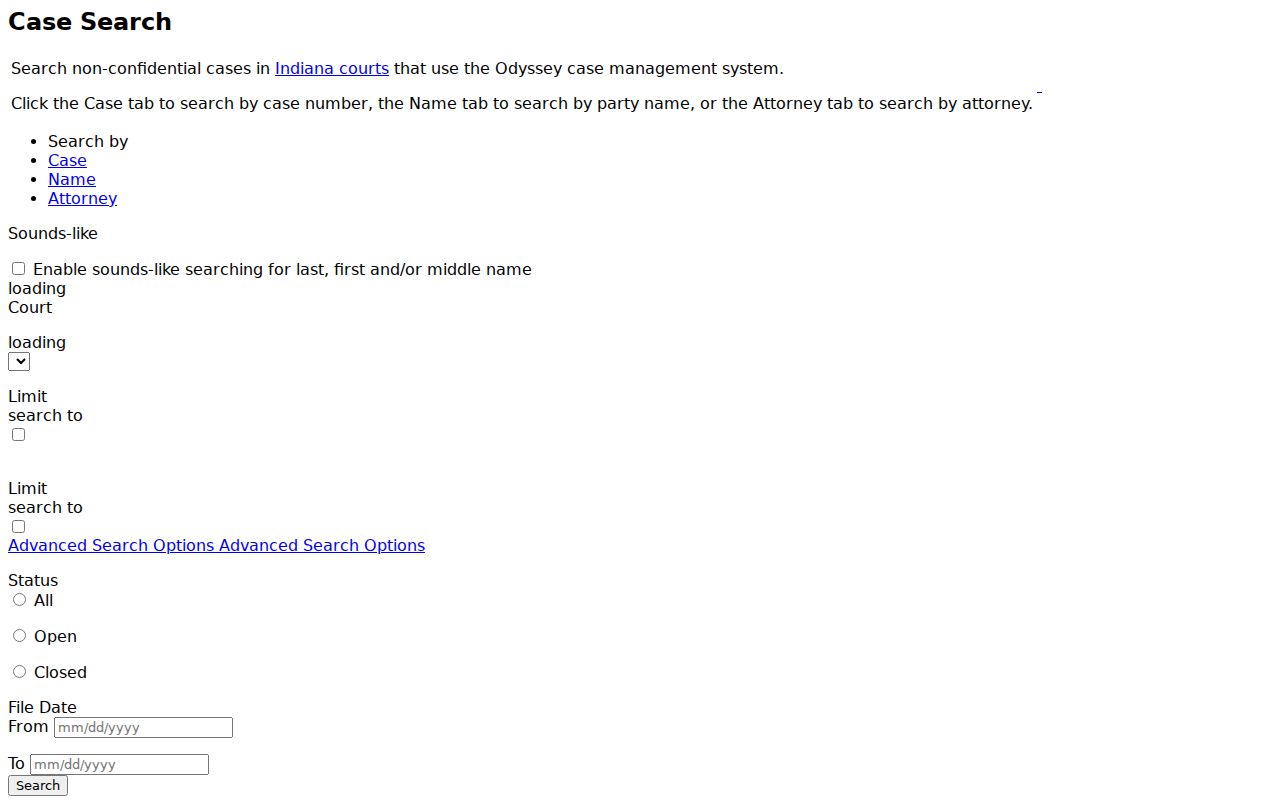
A result can name the case and list its public events. That is not a promise. Every filed document may not open online.
How to Search by Case Number
Nothing finds a Montgomery County case faster than a full Odyssey number. Indiana Administrative Rule 8 builds it in four groups. The first five characters mark the county and court. Next comes a two-digit year and month, then the case-type code and the sequence. Montgomery is county 54. Circuit uses C, while Superior uses D plus court number 01 or 02.
Try the synthetic example 54D02-2608-IF-000123, a Montgomery Superior Court 2 infraction format rather than a real matter. A Circuit Court felony-level format looks like 54C01-2608-F3-000123. A Superior Court 1 plenary civil format looks like 54D01-2608-PL-000123. MyCase tips allow dropping hyphens and leading zeroes, and trailing wildcards can widen part of a number. Exact numbers remain the safest bet.
Read the actual result instead of guessing the court from the case category. Montgomery's local rules permit transfers. The caption and court code show where the case sits now. Administrative Rule 8 supplies the current code table.
Narrow Montgomery County Name Results
A common name can flood you with results. Add one filter at a time, so a wrong guess does not screen out the case you want. Start with a Montgomery court. Then layer on a reasonable file-date range and a status. Use the sounds-like option only when spelling might vary. If a case could have moved among the three local courts, run the query again under the other Montgomery court labels.
Search clue: The 1,000-result cap is not proof that no case exists. It signals that the name query needs a court, date, or status filter.
Once a likely match appears, compare the full case number, caption, type, filing date, and court. Those fields beat a familiar name every time. An old record still missing may sit in the Clerk's archive, so ask about archive or retention status.
What a Case Search Shows
A public Montgomery County case search usually returns two things. One is the case header. The other is the nonconfidential Chronological Case Summary, or CCS. That summary lists filings, hearings, orders, and dispositions in order. An entry can link to a document. When no link appears, paper may still exist. It could be in-person-only, restricted, sealed, or simply not digitized.
| Case number | County, court, year-month, case type, and sequence. |
|---|---|
| Court and judge | The assigned Circuit or Superior Court and current judicial officer. |
| Caption and roles | Public party names and their roles in the matter. |
| Filed date and status | When the case opened and whether the system lists it as open, closed, or disposed. |
| CCS events | Filed pleadings, settings, orders, rulings, and disposition events that are public. |
| Financial summary | Public assessments, payments, or balance data, which MyCase warns may be incomplete. |
"Filed" only records a submission. It never means the judge granted anything. "Disposed" marks a system disposition, yet later review or compliance events can still follow. When an entry's exact effect matters, read the order tied to it.
Doxpop Adds Montgomery Hearing Search
Doxpop's hearing widget opens a second discovery path. It searches by case party, case number, or attorney. It can also limit the region to Montgomery County. It shines for hearing and calendar discovery, especially when a MyCase query feels awkward.
The partner interface page pairs with the manifest's Doxpop fee information. Together they separate open search functions from subscriptions and paid case images.
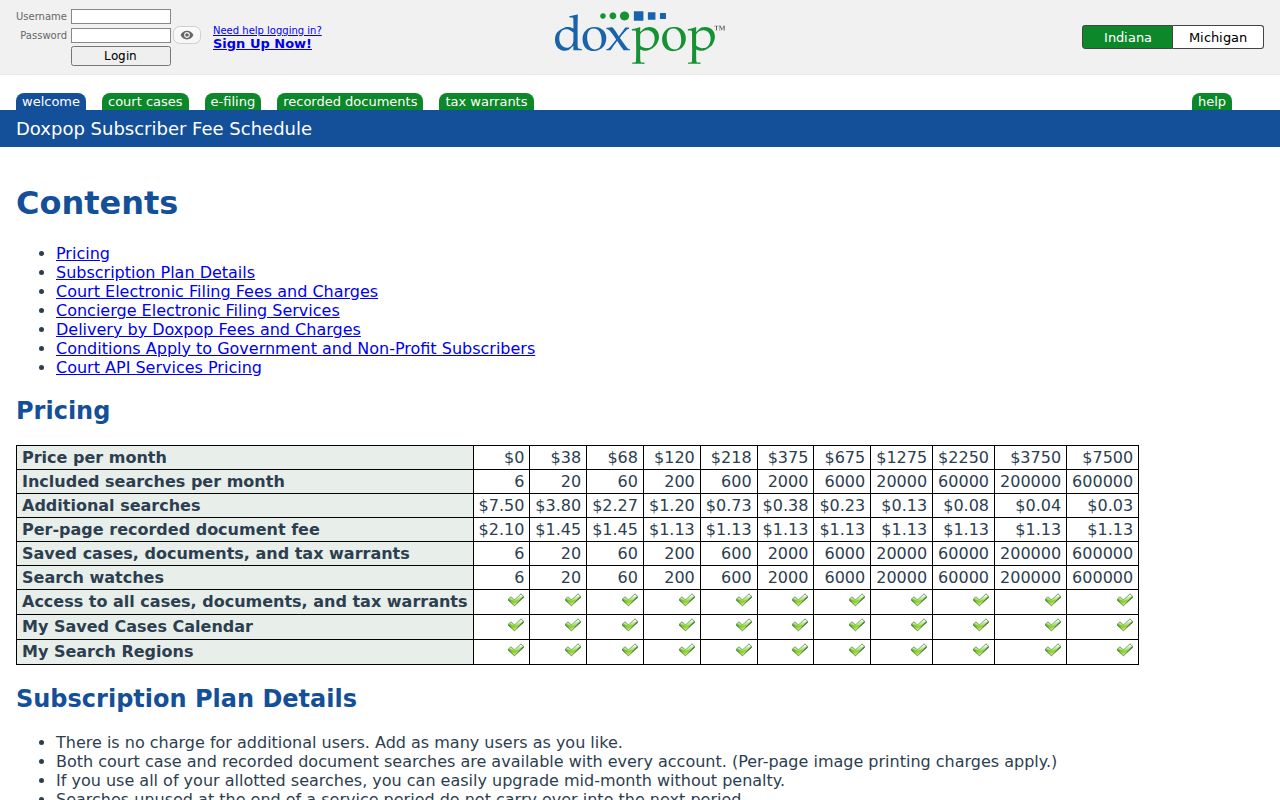
Doxpop says county coverage may begin in January 1990, and its county data note says foreign judgments are unavailable. Basic open-case information may be free. Images and subscriptions can cost money. Treat every Doxpop hit as a lead, because the Montgomery County Clerk resolves conflicts and supplies certified records.
County vs Statewide Case Search
Montgomery County offers no separate county-only case database. Instead, the county's Odyssey cases flow into MyCase, the statewide public layer. The local layer sits underneath it all: the Clerk's official file and counter. Doxpop adds a partner discovery route on top. Think of these as complementary channels. They are not competing certified records for a Montgomery County court docket.
| Channel | Best use | Limit |
|---|---|---|
| Indiana MyCase | Free name, number, citation, or attorney lookup | Only nonconfidential public data and selected documents |
| Doxpop | Hearing and partner case discovery | Partner data; fees may apply to images |
| Montgomery Clerk | Official CCS, file inspection, and certified copy | Contact is needed for current fees and procedure |
| Indiana ePay | Eligible traffic ticket search and payment | Not a full civil or criminal case search |
Online search not settling things? Call the Clerk at 765-364-6430 or visit Room 102, 100 E Main Street, Crawfordsville, during posted weekday hours. The county lists fax 765-364-6355, though it does not confirm whether fax, email, mail, or a drop-box works for record requests. Ask before you send any payment or documents.
When Montgomery Documents Stay Offline
What shows up online and what stays at the courthouse are two different things. The MyCase document access matrix sorts filings into three groups. Some go online. Others you must view at the courthouse. The rest stay closed to the public. So a docket entry can appear in the CCS while the PDF itself never does. That is routine, not a sign the filing vanished.
Ask the Clerk for what you want by name. Give the full case number plus the entry date or document title. Say whether you need a plain copy, a certified copy, or an exhibit. Inspection and transcripts count too. Transcripts often sit with the court reporter. Exhibits can fall under local custody and removal rules. The Clerk explains procedure but will not pick a filing or hand out legal advice.
Note: No official Montgomery page confirms a public lobby terminal, so ask the Clerk before planning a terminal-only visit.
Restricted Cases and Access Rules
Indiana starts from openness. Access to Court Records Rule 4 presumes public access. Rule 5 shields defined records: juvenile cases, adoptions, sealed matters, medical or treatment information, protected identifiers, and some protective-order or expungement material. A blank Montgomery County case lookup, in other words, cannot prove a case never existed.
For excluded material, the proper route runs through Access to Court Records Rule 9. That process may demand a verified written request, a court order, and a hearing. A general Indiana public-records request will not override a Rule 5 exclusion. It will not lift a sealing order either. Never infer protected facts from an absence, and never republish redacted details.
The public search still earns its keep. Use it to track your own case or confirm a hearing. Read public orders there too. You can also follow a matter of local interest in Montgomery County. When completeness or certification matters, go further. Confirm the result with Sondra Dittmer Sixberry, Clerk of the Circuit Court.
Federal Cases Need PACER
Indiana MyCase stops at the state line's edge; federal cases are not included. Montgomery County sits in the Southern District of Indiana's Indianapolis Division. Search those files through the PACER Case Locator or the district's CM/ECF public-access route. Federal appeals go to the Seventh Circuit.
This boundary matters. State and federal cases can carry similar captions yet separate numbers, dockets, judges, and custodians. Always preserve the court name with every result. Once you locate a state case, go deeper. Turn to the Montgomery County court record search procedures.
Montgomery Case Search Fallbacks
When the statewide screen leaves doubt, local sources point the way. The county court-calendar service documents a local calendar route. The Montgomery local rules explain which court normally receives each case type. Neither one replaces the live case result.
Use the calendar route to spot a possible hearing. Use the assignment rule to decode the court label on a Montgomery County court docket. Then verify the CCS or order through MyCase and the Clerk. That layered check helps after a transfer, a reset, or a narrow online result. It prevents one mistake in particular. A partner calendar is not the certified Montgomery County case record.