
Searching Montgomery County Criminal Dockets
Indiana MyCase is the free place to begin a public Montgomery County criminal docket search. If you have the full case number, use it. A party-name search works too. Narrow it by court, status, or filing date. The Montgomery filter covers Circuit Court, Superior Court 1, and Superior Court 2. From the matching result, save the case number, court label, case type, and caption. Those fields sort out people with similar names. They also show which court owns the criminal CCS.
The CCS, short for Chronological Case Summary, is the docket-style history of the case. One catch: it can list an event without attaching the filed document. MyCase itself warns that web data can hold errors. Financial details may be incomplete. Need an official or certified copy? Go to the Montgomery County Clerk in Room 102 at 100 East Main Street, Crawfordsville. The phone is 765-364-6430, answered during posted weekday hours.
- Open MyCase and choose Case or Name search. Select a Montgomery court when a broad search returns too many results.
- Enter the Odyssey case number, or use a last name with the available first-name, status, court, and date filters.
- Match the complete number, court, filing date, caption, and criminal case-type code before opening the CCS.
- Read charges, settings, motions, plea events, disposition, sentence, and later probation or review entries in date order.
- Ask the Clerk for inspection or a certified copy when the public screen lacks the needed document or official certification.
Montgomery Criminal Docket Codes
Under Indiana Administrative Rule 8, a case number does real routing work. The first five characters name the county and court. Montgomery County carries county code 54. Its active labels are 54C01 for Circuit Court, 54D01 for Superior Court 1, and 54D02 for Superior Court 2. After that come a year-and-month group, a case-type group, and a sequence number. A synthetic example looks like 54C01-2608-F3-000123.
Criminal types include MR for murder, CF for felony, and CM for misdemeanor. F1 through F6 mark felony levels. IF covers infractions and OV covers ordinance violations. Remember that a code is only a label, never the outcome. A transfer order can also move a case between courts. Trust the current court shown in MyCase and the CCS over the number alone.
Note: Keep the complete Odyssey number. County, court, filing group, case type, and sequence each narrow a Montgomery criminal docket search.
Inside a Montgomery County Criminal Docket
A Montgomery County criminal CCS keeps allegations separate from what the court actually did. The header names the case and its assigned court. Charge rows may list a statute, an offense label, and a count number. Some add a level, class, or amendment history. As the case moves, entries can record counsel appearances, initial hearings, probable-cause events, motions, pleas, trials, sentences, and compliance reviews. Open the linked order when one is public. An event title by itself may not state the terms of the ruling.
| Case Number | The Rule 8 county, court, date, type, and sequence groups, such as the synthetic 54D02-2608-CM-000123. |
|---|---|
| Charge | Count number, cited law, offense description, level or class, and any amendment shown publicly. |
| Setting | Initial hearing, pretrial, motion, trial, sentencing, probation, or later review date and event title. |
| Plea and Finding | Separate plea entries from a court finding, dismissal, or other disposition. |
| Financials | Public assessments, restitution, fees, payments, and balance, which MyCase says may be incomplete. |
| Access Status | Public document link, in-person-only item, sealed entry, redaction, or other restricted classification. |
Montgomery Criminal Docket Routing
The Montgomery County local rules split criminal filings by the highest charge in the case. That local split is why a generic county search can miss a match when only one court is selected. Related counts may follow an existing case, and a judge can transfer a case by order.
| Assigned Court | Criminal Work | Search Check |
|---|---|---|
| Circuit Court | Murder and Level 1 through Level 5 felonies | Look for 54C01 and the matching MR or felony type. |
| Superior Court 1 | Level 6 felonies and specified alcohol cases with a habitual vehicular substance offender charge | Look for 54D01, then read all joined charges. |
| Superior Court 2 | Other misdemeanors, plus infractions and ordinance matters | Look for 54D02 and CM, IF, or OV as applicable. |
Joined charges follow the highest felony. Even so, the live case caption, the current court label, and any transfer entries beat an assumption drawn only from the offense name.
How a Criminal Case Moves
Think of a Montgomery criminal docket as a timeline, not a one-line result. The charging filing and initial hearing often come first. Counsel appearances, probable-cause or waiver events, pretrial conferences, motions, and new settings follow. A plea and a finding are distinct steps. So are a dismissal, a conviction, and a sentence. Later steps can include a modification, a probation event, or an expungement. Read each dated entry and any linked order before you describe what happened.
Docket flow: Filing › Arraignment › Pretrial › Plea or Trial › Disposition › Sentencing
Activity can continue after the main disposition. Financial entries, probation review, alleged violations, modification requests, and compliance events may keep landing on the CCS. A closed label alone does not explain each count or later order.
Montgomery Criminal Bond Entries
The local bond rule sets out general conditions and a schedule, but judicial discretion and detention exceptions still control. Typical conditions require appearing in court, committing no new offense, telling the court about any address change, staying in Indiana without permission to leave, and following other court orders. A docket may show a bond amount, its type, conditions, a modification, or a failure-to-appear event.
Read the order, not just the amount. The charge level, detention category, prior orders, and judicial findings can change how the local schedule applies.
A failure-to-appear entry needs its court-order context too. The local rule requires an order. A short docket label will not tell you about a warrant, release status, or final outcome, so open the relevant order and check later CCS entries first.
Courts That Hold Criminal Dockets
One office holds nearly everything. The Montgomery County Clerk keeps the criminal court records. Circuit Court, Superior Court 1, and Superior Court 2 are all covered. A Montgomery County Court and a Crawfordsville City Court once existed, but the state lists both as abolished. Ordinance and infraction cases now move through the county system, mostly Superior Court 2 under local assignment rules.
The Indiana Odyssey courts list backs this up, naming all three active Montgomery courts. Convictions appealed out of Montgomery County go to the Court of Appeals of Indiana. A petition for transfer can carry a case to the Indiana Supreme Court. That appellate docket is a separate record. Federal criminal matters appear in neither MyCase nor the Montgomery County criminal docket.
The Indiana Judicial Branch page adds context. It places these local criminal dockets in the wider state court structure.
That official source also explains the split. Treat a county trial docket and any appellate docket that follows it as two separate records, each with its own case number and its own filings.
Missing Montgomery Criminal Docket Files
A dead MyCase link is not the end of the story. The document may sit behind in-person-only access, lack digitization, or fall outside public view. Write down the case number, the entry date, and the document title first. Then read the MyCase document access information. Ask the Clerk directly whether the filing can be inspected or copied.
For paper, go to the Clerk's counter. Ask about identification, copying methods, fees, certification, and turnaround, since Montgomery County offers no online certified-copy form. Mail requests may work. But the county publishes no payment or postage instructions, so confirm every detail with the Clerk before mailing anything.
The county justice services directory lists local programs connected to the courts as well.
Those program pages can clarify a CCS event on the docket. Treatment details, though, stay restricted and never appear in the open criminal docket.
Montgomery Criminal Docket Appeals
An appeal adds a second layer on top of the county CCS. The Montgomery trial docket records the notice of appeal and record preparation. Yet the case itself moves to the Court of Appeals of Indiana. A granted transfer petition can reach the Indiana Supreme Court. Once the trial CCS gives you an appellate cause number, search that docket on its own.
Federal charges travel a different road. They run through the Southern District of Indiana and the Seventh Circuit, never MyCase. Keep the Montgomery County case number and the appellate number apart. That keeps events in the two court records separate.
Sealed Dockets and Public Access
Indiana court records start open to the public. Still, a Montgomery criminal docket is not a police file. Investigative material can be withheld. So can protected victim or witness details, medical and treatment information, juvenile records, sealed motions, expunged matters, and confidential program records. A blank docket search proves nothing about whether a case ever existed.
Key access rules:
Access to Court Records Rule 4 makes court records accessible unless another rule excludes them.
Access to Court Records Rule 5 identifies confidential, sealed, redacted, juvenile, treatment, and other protected material.
Access to Court Records Rule 9 governs requests for excluded records and may require a verified request, order, or hearing.
Rule 5 draws the access lines that govern Montgomery County criminal dockets.
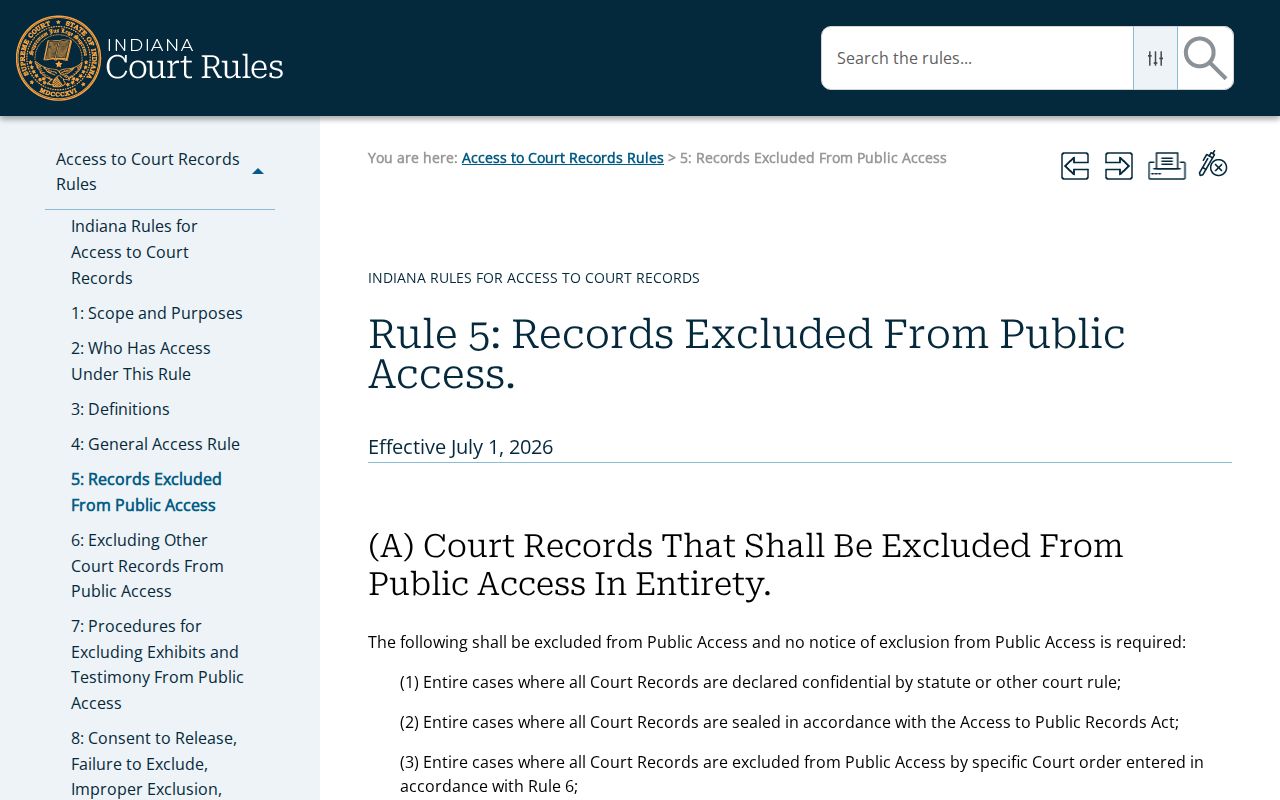
Turn to Rule 9 when a lawful request involves excluded material. No general public-records request can override a court's restriction.